How to evaluate a data platform: the 9 criteria we use
Why a framework, not a checklist
Most data platform comparisons we see online are written by vendors. They emphasize the criteria where the vendor's product wins. That makes them useful for marketing… and useless for procurement.
A framework is different. It commits you upfront to a fixed set of criteria, applied consistently across every option, before scoring begins. That sequence matters: choosing your criteria after you've seen the demos is how organisations end up with the platform whose sales team showed up first, not the platform that actually fits.
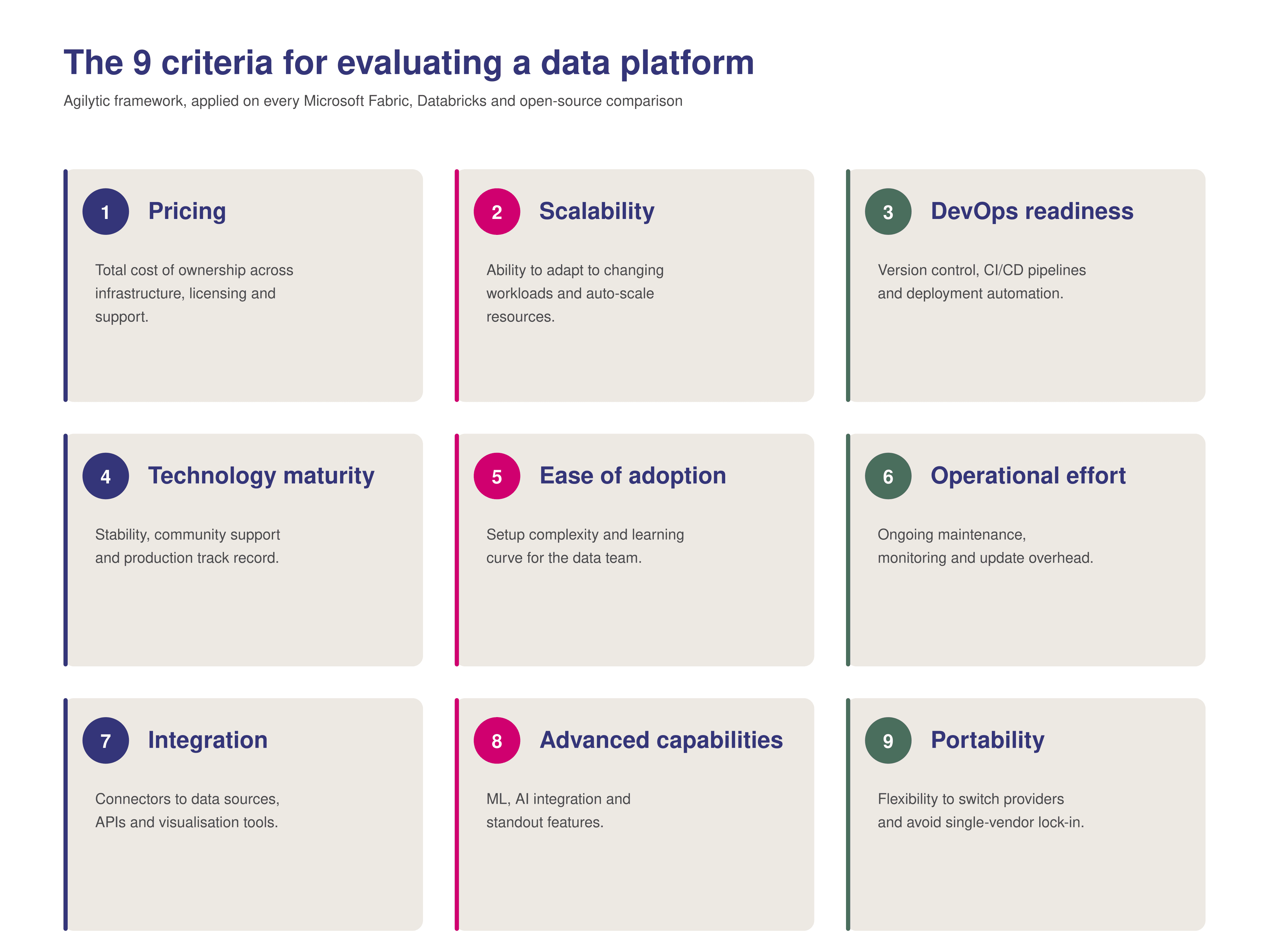
The nine criteria below are the ones we apply on every data platform engagement. We arrived at this list through 300+ projects across Belgian and European clients since 2015. Although it is not the only valid set of criteria, it is the one we have found genuinely covers what matters when an SME or mid-market organisation chooses a platform they will live with for years.
The 9 criteria
1. Pricing
Pricing rarely decides the platform in itself, but it routinely derails the implementation. Start by looking at total cost of ownership across three buckets: infrastructure, licensing, and support.
For Microsoft Fabric, that means modeling F-SKU capacity tiers and understanding that each capacity step roughly doubles the bill.
For Databricks, it means understanding DBU consumption and committing to discipline (auto-termination, right-sized clusters).
For an open-source stack, the licensing line is small but engineering effort becomes the largest hidden cost.
2. Scalability
As you know, scalability is the ability to handle changing workloads without redesign. It needs to manage peak volumes and elastic response; for example, spinning up for a quarterly close and back down for normal traffic.
Fabric scales within purchased capacity.
Databricks scales per cluster with fine-grained autoscaling.
Open-source scales with your team's Kubernetes maturity.
None of these answers is wrong. The question is which one matches your real usage pattern.
3. DevOps readiness
DevOps readiness measures how easily the platform integrates with modern engineering practices: Git-based version control, CI/CD pipelines, infrastructure as code… These are essential on a daily basis, and entail significant changes to reports, pipelines, or data models; they can be version-controlled, reviewed, and safely promoted from development to production – rather than edited by hand in the live system where a single mistake is hard to trace and harder to undo.
Databricks is the reference for stability here, with Asset Bundles and a mature Terraform provider.
Fabric has improved fast and now covers standard needs with Deployment Pipelines and the official fabric-cicd library.
Open-source is technically most flexible, but the entire pipeline must be designed and maintained in-house.
4. Technology maturity
Maturity is not just "how old is the product." It's stability, community support, and production track record.
Fabric reached general availability in late 2023, which means parts of it are still maturing.
Databricks has been around for more than a decade and is battle-tested.
Open-source components are individually mature, but their integration and long-term coherence are the team's responsibility.
Mind you: we don't penalize platforms for being young! We only flag where the youth shows up and can be an issue, depending on the use cases you envision in the next 18-24 months.
5. Ease of adoption
Ease of adoption is about your team, not the technology. A platform that requires three new senior hires to operate is not "easy," no matter how slick the marketing video. Assess against the team that will actually run the platform: skills already present, headcount available, realistic learning curve...
Fabric is the most accessible for teams already fluent in Microsoft 365 and Power BI.
Databricks typically needs PySpark and SQL fluency.
Open-source needs the broadest skill mix.
6. Operational effort
Operational effort is the ongoing maintenance, monitoring, and update burden once the platform is live.
Full SaaS platforms like Fabric carry the lowest run effort, because Microsoft handles infrastructure, patching, and scaling.
Managed SaaS like Databricks asks for cluster and cost governance.
Open-source asks for everything: upgrades, security patches, monitoring dashboards.
This is the line item that most often blows up data team capacity in year two.
7. Integration
Integration is the breadth and quality of connectors to data sources, APIs, and downstream tools.
Fabric ships with around 300 native connectors and integrates tightly with Power BI and the wider Microsoft ecosystem.
Databricks offers Spark connectors, Lakehouse Federation, and Partner Connect.
Open-source uses Airbyte, Singer, Kafka, and whatever your team chooses to build.
More connectors is not always better, but fewer connectors is usually more work.
8. Advanced capabilities
This is the criterion that gets oversold most often. Advanced capabilities means real machine learning, AI integration, decentralized data products, and the standout features that justify the platform's price tag.
Databricks is the reference here, with MLflow, Feature Store, Mosaic AI, and Unity Catalog.
Fabric is ramping up fast, with Data Agents, Copilot, and native Azure OpenAI integration.
Open-source is possible with MLflow OSS or Kubeflow, but assembly is on you.
Match this criterion to what you actually plan to build.
9. Portability
Portability is the exit cost. Can you take your code, your data, and your team somewhere else if the vendor relationship sours, or if a regulatory change forces a move?
Fabric is the most tightly integrated with the Microsoft ecosystem, so lock-in is high and should be assumed, not denied.
Databricks sits in the middle: PySpark and Delta Lake are portable, but Workflows and Unity Catalog are proprietary.
Open-source is the most portable by design.
Portability matters most when sovereignty or vendor risk are on the agenda. Otherwise it's a tiebreaker.
How we apply this framework in practice
Two things make the framework useful instead of decorative.
First, every shortlisted platform gets scored on every criterion, even the ones that seem obvious. The discipline of forcing yourself to articulate why Databricks scores high on advanced capabilities, instead of just assuming it, is what surfaces blind spots.
Second, the criteria are not equally weighted. For an SME with a small data team and Power BI already in place, ease of adoption and operational effort weigh heavily. For a regulated organisation with a large internal team, portability and DevOps readiness weigh more. We adjust the weighting before scoring (not after) so the comparison reflects the client's reality rather than the vendor's pitch.
A typical Agilytic scoping engagement spends one to two weeks shortlisting two or three options and scoring them through this framework. The output is a one-page recommendation that names the platform, lists the trade-offs, and explains the weighting choices. It's the document we wish more companies brought to procurement.
When to use this framework
Any time you're evaluating a data platform decision worth more than 50,000 EUR over its lifetime, this framework is worth running. That includes initial platform selection, but also major version upgrades. A Synapse to Fabric migration, for instance, deserves the same rigor as choosing between Fabric and Databricks from scratch. Skipping the framework usually means defaulting to whatever the loudest vendor recommended, which is rarely the right answer.
💡 If you are weighing Microsoft Fabric specifically, this framework feeds directly into our Microsoft Fabric consulting practice.
Looking to apply this to your own platform decision? Book a 30-minute scoping call.